Gente digital

New York

New York Times

New York Times
CMYK

Nxxx,2009-09-18,A,001,Bs-BK,E3

Late Edition
Today, partly sunny and warmer, high 76. Tonight, becoming clear, light winds, low
56. Tomorrow, brilliant sunshine, a slight breeze, high 70. Weather map is on Page
A27.

VOL. CLIX . . No. 54,802

© 2009 The New York Times

NEW YORK, FRIDAY, SEPTEMBER 18, 2009
NEWS ANALYSIS


OBAMA RESHAPES Scaling Back A MISSILE SHIELD An ’80s Vision TO BLUNT TEHRAN
New Strategy Stands Star Wars on Its Head
By DAVID E. SANGER and WILLIAM J. BROAD

BUSH PLAN IS SCRAPPED
Shorter-Range Rockets Become Focus of the System in Europe
By PETER BAKER

POOL PHOTO BY DOUGLAS HEALEY

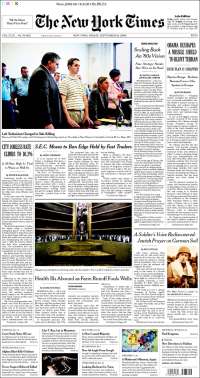
Lab Technician Charged in Yale Killing
Raymond Clark III, center, with his lawyers at his arraignment on Thursday in New
Haven in the death of Annie M. Le. Page A24.

CITY JOBLESS RATE S.E.C. Moves to Ban Edge Held by Fast Traders CLIMBS TO 10.3%
By JENNY ANDERSON

A 16-Year High Is Tied to Woes on Wall St.
By PATRICK McGEEHAN

Continuing layoffs on Wall Street drove New York City’s unemployment rate to 10.3
percent in August, a 16-year high that underscores the need to retrain former financial
services workers for other jobs, state officials said Thursday. In the year since
the Lehman Brothers investment bank collapsed and others had to be rescued from failing,
the number of unemployed city residents has risen to more than 415,000, the highest
total on record. The stillshrinking financial sector, which had been the main engine
of employment growth in the city before the downturn, has essentially been declared
to be in a state of emergency. The State Department of Labor has begun using a “national
emergency grant” of $11 million in federal funds to help those laid off on Wall
Street shift into other fields, like health care and education. Emphasizing the need
for such a shift, M. Patricia Smith, the state labor commissioner, said, “Our economists
don’t see the financial-services sector ever coming back as strong as it was.”
Ms. Smith joined Gov. David A. Paterson and Assembly Speaker Sheldon Silver at a
news conference in Lower Manhattan to discuss the latest jobs data and promote the
retraining program. Mr. Paterson said the latest increases in the state and city
unemployment rates showed that the recession was continuing in New York. Referring
to the recent pronouncement from Ben S. Bernanke, the chairman of the Federal Reserve,
that the national recession is probably over, Mr. Paterson said, “What he’s saying
about the national recession doesn’t apply to us.” He said New York faced at
least another year of “tough sledding.” The city’s unemployment rate, which
rose from 9.5 percent in July, is now well above the national rate of 9.7 percent.
Until July, unemployment had been the same or lower in the city than it was in the
country for more than 18 months. Last month, the state’s unemployment rate rose
Continued on Page A28

It is an obscure art of Wall Street, a technique that gives a scattering of traders
an edge over everyone else — and the Securities and Exchange Commission wants to
stamp it out. The S.E.C. on Thursday proposed banning what are known as flash orders,
which use powerful computers to glimpse at investors’ orders. The practice is often
associated with a controversial corner of finance called high-frequency trading,
which has grown, largely hidden from view, into a potent force in the markets.

The proposed ban was announced on the same day that the S.E.C. put forward new rules
for credit ratings agencies, which were widely criticized for their role in the financial
crisis. Together, the moves telegraphed a tougher line from the commission after
a series of prominent missteps, including its failure to spot the Ponzi scheme orchestrated
by Bernard L. Madoff. Critics say flash orders favor sophisticated, fast-moving traders
at the expense of slower market participants. Using lightningquick computers, high-frequency
traders often issue and then cancel orders almost simultaneously and get an early
peek at how oth-

ers are trading. Mary L. Schapiro, the chairwoman of the S.E.C., said on Thursday
that in proposing the ban, the commission was trying to balance the often competing
interests of long-term investors and short-term traders. The proposal requires a
second vote by the commission to become binding. “Flash orders may create a two-tiered
market by allowing only selected participants to access information about the best
available prices for listed securities,” she said during a meeting in Washington.
Other modern Continued on Page A3

WASHINGTON — The new plan that President Obama laid out for a missile shield against
Iran on Thursday turns Ronald Reagan’s vision of a Star Wars system on its head:
Rather than focusing first on protecting the continental United States, it shifts
the immediate effort to defending Europe and the Middle East. It is a long way from
the impermeable shield that President Reagan described in glowing terms in 1983,
an announcement that turned into a diplomatic triumph even while it was a technological
flop. Ever since, missile defense has always been more about international politics
than about new military technology. In the last years of the cold war, it helped
nudge the Soviets toward agreements that sharply reduced nuclear arsenals, a process
that Mr. Obama hopes to revive at the end of the year. In the George W. Bush years,
it was about expanding NATO and, under the cover of building antimissile bases to
protect against North Korean attack, a subtle warning to China that its power in
the Pacific would not go unchecked. Now, in the age of Obama, the vision has descended
from the stars to sea level. A president who was still in college during Reagan’s
famous missile defense speech has turned a scaled-back version of the technology,
which would first be based on ships, to a new mission: Convincing Israel and the
Arab world that Washington is moving quickly to counter Iran’s influence, even
as it opens direct negotiations with Tehran for the first time in 30 years. For Mr.
Obama, it is a step fraught with some risk. Within hours of his announcement, charges
were flying that in his first major confrontation with the Russians, he had backed
down, giving in to Moscow’s opposition to the Bush plan to place missile defenses
in Poland and the Czech Republic. “The politics of this was driving him in the
other direction, against appearing to back down,” Continued on Page A12

WASHINGTON — President Obama scrapped his predecessor’s proposed antiballistic
missile shield in Eastern Europe on Thursday and ordered instead the development
of a reconfigured system designed to shoot down short- and medium-range Iranian missiles.
In one of the biggest national security reversals of his young presidency, Mr. Obama
canceled former President George W. Bush’s plans to station a radar facility in
the Czech Republic and 10 ground-based interceptors in Poland. Instead, he plans
to deploy smaller SM-3 interceptors by 2011, first aboard ships and later in Europe,
possibly even in Poland or the Czech Republic. Mr. Obama said that the new system
“will provide stronger, smarter and swifter defenses of American forces and America’s
allies” to meet a changing threat from Iran. Administration officials cited what
they called accumulating evidence that Iran had made more progress than anticipated
in building short- and medium-range missiles that could threaten Israel and Europe
than it had in developing the intercontinental missiles that the Bush system was
more suited to counter. But the decision churned domestic and international politics
as Republican critics at home accused Mr. Obama of betraying allies and caving in
to Russian pressure, while officials in Eastern Europe expressed discomfort and confusion
at the dramatic shift. President Dmitri A. Medvedev of Russia, who is to meet with
Mr. Obama in New York next week, reacted cautiously as Moscow tried to determine
whether the new system was less threatening to its own security. Mr. Obama’s transformation
of the missile defense program is one of his administration’s sharpContinued on
Page A12

A Soldier’s Voice Rediscovered: Jewish Prayer on German Soil
By PAUL VITELLO

DAMON WINTER/THE NEW YORK TIMES

Dangerous pollutants in drinking water can be traced to the runoff of waste from
farm animals.

Health Ills Abound as Farm Runoff Fouls Wells
By CHARLES DUHIGG
TOXIC WATERS

260 Million Gallons amounts are excessive, bacteria and chemicals can flow into the
ground and contaminate residents’ tap water. In Morrison, more than 100 wells were
polluted by agricultural runoff within a few months, according to local officials.
As parasites and bacteria seeped into drinking water, residents suffered from chronic
diarrhea, stomach illnesses and severe ear

MORRISON, Wis. — All it took was an early thaw for the drinking water here to become
unsafe. There are 41,000 dairy cows in Brown County, which includes Morrison, and
they produce more than 260 million gallons of manure each year, much of which is
spread on nearby grain fields. Other farmers receive fees to cover their land with
slaughterhouse waste and treated sewage. In measured amounts, that waste acts as
fertilizer. But if the

infections. “Sometimes it smells like a barn coming out of the faucet,” said
Lisa Barnard, who lives a few towns over, and just 15 miles from the city of Green
Bay. Tests of her water showed it contained E. coli, coliform bacteria and other
contaminants found in manure. Last year, her 5-yearold son developed ear infections
that eventually required an operation. Her doctor told her they were most likely
caused by bathing in polluted water, she said. Yet runoff from all but the largContinued
on Page A18

Like many veterans, Max Fuchs did not talk much about what he did in the war. His
children knew he landed at Omaha Beach. Sometimes, they were allowed to feel the
shrapnel still lodged in his chest. And once, he had told them, he sang as the cantor
in a Jewish prayer service on the battlefield. On Oct. 29, 1944, at the edge of a
fierce fight for control of the city of Aachen, Germany, a correspondent for NBC
radio introduced the modest Sabbath service like this: “We bring you now a special
broadcast of historic significance: The first Jewish religious service broadcast
from Germany since the advent of Hitler.” Mr. Fuchs, now 87 and living on the Upper
West Side, was 22 that day at Aachen. “I was just as much scared as anyone else,”
he said in an interview in his Manhattan apartment. “But since I was the only one
who could do it, I tried my best.” Well-known in its time, the bat-

Pfc. Max Fuchs in prayer on the battlefield at Aachen.
tlefield service became lost in obscurity, where it might have remained except for
an archivist’s chance find and then, fast forward, unlikely fame on YouTube —
where the 1944 service has drawn 310,000 hits — for Mr. Fuchs. His grandchildren
have been Continued on Page A26

NATIONAL A13-22

Like T. Rex, but in Miniature
Paleontologists said that they had found the remains of what amounted to a miniature
prototype of Tyrannosaurus rex, complete with the oversize head, powerful jaws, long
legs and puny arms that were hallmarks of the king of the dinosaurs. Named Raptorex
kriegsteini, it PAGE A6 was discovered in China.

NEW YORK A24-28

EDITORIAL, OP-ED A30-31

Court Voids Voter ID Law
An Indiana court struck down a voter identification law that the United States PAGE
A14 Supreme Court had upheld.
INTERNATIONAL A6-12

A New Council Majority
Black, Asian and Hispanic members are finally poised to become a majority on PAGE
A24 the New York City Council.
BUSINESS DAY B1-7

Paul Krugman
ONLINE

PAGE A31

New Directions in Fashion
Eric Wilson of The Times narrates a video on Fashion Week in New York, where designers,
facing the creative challenge of designing for a new decade on the tail end of a
recession, displayed torn cuffs and redefined the power suit.
nytimes.com/fashion

Afghan Blast Kills 6 Italians
Prime Minister Silvio Berlusconi said Italy was considering a quick withdrawal from
Afghanistan after a suicide bomb attack on an armored vehicle. PAGE A6

New Ad Angle From Google
Google is expanding in display ads with an auction site where advertisers can PAGE
B1 bid for online ad space.
SPORTSFRIDAY B10-15 WEEKEND C1-34

A Modernist’s Moment, Again
Wassily Kandinsky, whose “Yellow-RedBlue” is shown above, is the subject of a
retrospective at the Guggenheim Museum, as he has been more than once in the museum’s
50-year history. A review PAGE C23 by Roberta Smith.

Terror Suspect Believed Killed
Indonesian officials say Noordin Muhammad Top, a major terrorism suspect PAGE A11
in Southeast Asia, is dead.

Looking Backward in Texas
The Dallas Cowboys’ new stadium is meant to be a 21st century facility, but it
evokes Eisenhower America. PAGE B10


© Kiosko.net | terms and conditions